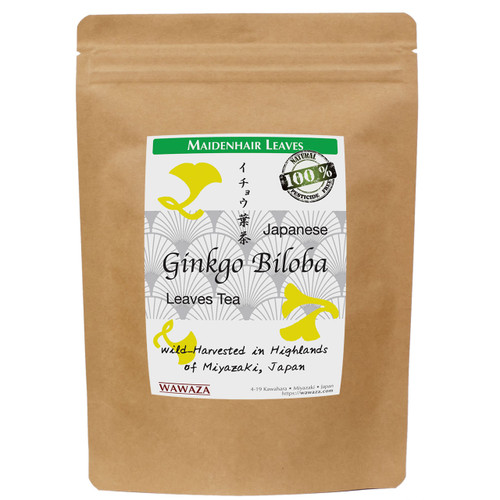
A smooth Japanese herbal tea with an autumnal, woodsy aroma.
Naturally contains antioxidants and unique compounds called ginkgolides. Ginkgo leaf compounds have been extensively studied for their neuroprotective effects and may help increase blood flow to the brain, protect brain cells, and support neurological health. See the references below.
Studies point to possible benefits for:
- Improving Memory & Neurological Health
- Promoting Blood Flow to the Brain
- Supporting Age-Related Cognitive Health
Easy to prepare. See how below.
Serve hot, cold, or over ice.
Wild-Harvested • All-Natural • Pesticide-free
Prepared from freshly picked leaves and cut into strips using the traditional Japanese tanzaku-giri (短冊切り) method for optimal brewing.
Product Details
Type: Herbal
Region: Miyazaki Prefecture, Japan
Caffeine: None
Flavor: Autumnal and woodsy with a smooth vegetal aftertaste
Color: Pale yellow-green
Ingredients: 100% Japanese Ginkgo biloba leaves
Net Weight: 50 g
Product of Japan
About Ginkgo Biloba
Ginkgo biloba, also known as the maidenhair tree, belongs to one of the oldest surviving tree lineages on Earth. Its distinctive fan-shaped leaves and remarkable longevity have made it one of the most recognizable trees in Japan.
Ginkgo trees can live for centuries and are widely planted at temples, shrines, parks, school grounds, and along city streets throughout Japan.
Ginkgo in Japanese Culture
Ginkgo trees are admired in Japan for their resilience, beauty, and long life. Ancient specimens are particularly cherished, and the distinctive two-lobed leaves appear frequently in family crests, kimono patterns, accessories, and other traditional designs.
One remarkable local example is the Grand Ginkgo in Takaoka, Miyazaki. This female tree is believed to be about 800 years old and is designated a National Natural Monument of Japan. Each autumn, its brilliant yellow foliage is celebrated by the local community.
The traditional hairstyle resembling ginkgo leaves shown in the picture gallery is called Ichō-gaeshi (ginkgo chignon).
About the Name
The name ginkgo entered Western botanical usage through the Japanese name associated with the kanji 銀杏, meaning “silver apricot.” The scientific name Ginkgo biloba refers to the characteristic two-lobed form of many ginkgo leaves.
How to Brew
Quick Brew Method
The following instructions are for making 4 cups (800 ml total).
- Add 5 g (about 2 heaping tablespoons) of ginkgo leaves to a pot.
- Add 4 cups (800 ml) of near-boiling water.
- Brew for about 3 minutes.
- Strain and serve hot, cold, or over ice.
Traditional Japanese Brew Method (Senjiru)
This traditional Japanese brewing method yields a deeper infusion.
- Pour a little more than 4 cups of cold water into a pot.
- Add 5 g (about 2 heaping tablespoons) of ginkgo leaves.
- Heat to a full, rolling boil.
- Turn the heat down and simmer for 10 minutes.
- Turn the heat off and wait for about 10 minutes.
- Strain and serve.
References
- Neuroprotective Effects of Ginkgo biloba Extract - Cellular and Molecular Life Sciences. 2003;60(9):1779–1792. DOI: 10.1007/s00018-003-3080-1.
- The Neuroprotective Mechanisms of Ginkgolides and Bilobalide in Cerebral Ischemic Injury: A Literature Review - Molecular Medicine. 2019;25:57. DOI: 10.1186/s10020-019-0125-y.
- Effects of Ginkgo biloba in Dementia: Systematic Review and Meta-Analysis - BMC Geriatrics. 2010;10:14.
- Ginkgo biloba and Donepezil: A Comparison in the Treatment of Alzheimer's Dementia in a Randomized Placebo-Controlled Double-Blind Study - European Journal of Neurology. 2006;13(9):981–985. DOI: 10.1111/j.1468-1331.2006.01409.x.
- Treatment of Dementia and Mild Cognitive Impairment with or without Cerebrovascular Disease: Expert Consensus on the Use of Ginkgo biloba Extract, EGb 761 - CNS Neuroscience & Therapeutics. 2019;25(2):288–298. DOI: 10.1111/cns.13095.
- Ginkgo biloba Extract EGb 761 in the Treatment of Patients with Mild Neurocognitive Impairment: A Systematic Review - Neuropsychiatric Disease and Treatment. 2023.
- Ginkgo biloba: A Smart Drug? A Systematic Review of Controlled Trials of the Cognitive Effects of Ginkgo biloba Extracts in Healthy People - Human Psychopharmacology. 2002;17(8):405–414.